Trust is an aspect of any relationship and one that is rarely felt until it’s broken. When you enter into a relationship, there is what is called “blind trust”. This is an automatic baseline of trust in a relationship that is derived from the basic functioning and survival of the relationship. Meaning: there is a general sense of understanding we have a mutually shared goal in the success of this relationship and so you aren’t going to do anything that messes that up. Our shared “goal” ideally drives this notion that we are at all times doing things that are in the positive interest of the other person, and that there is an agreed-upon sense of goodwill. That’s the blind part. When trust is destroyed, it is no longer blind…it must be earned and proven.
That’s where trust layers come in.
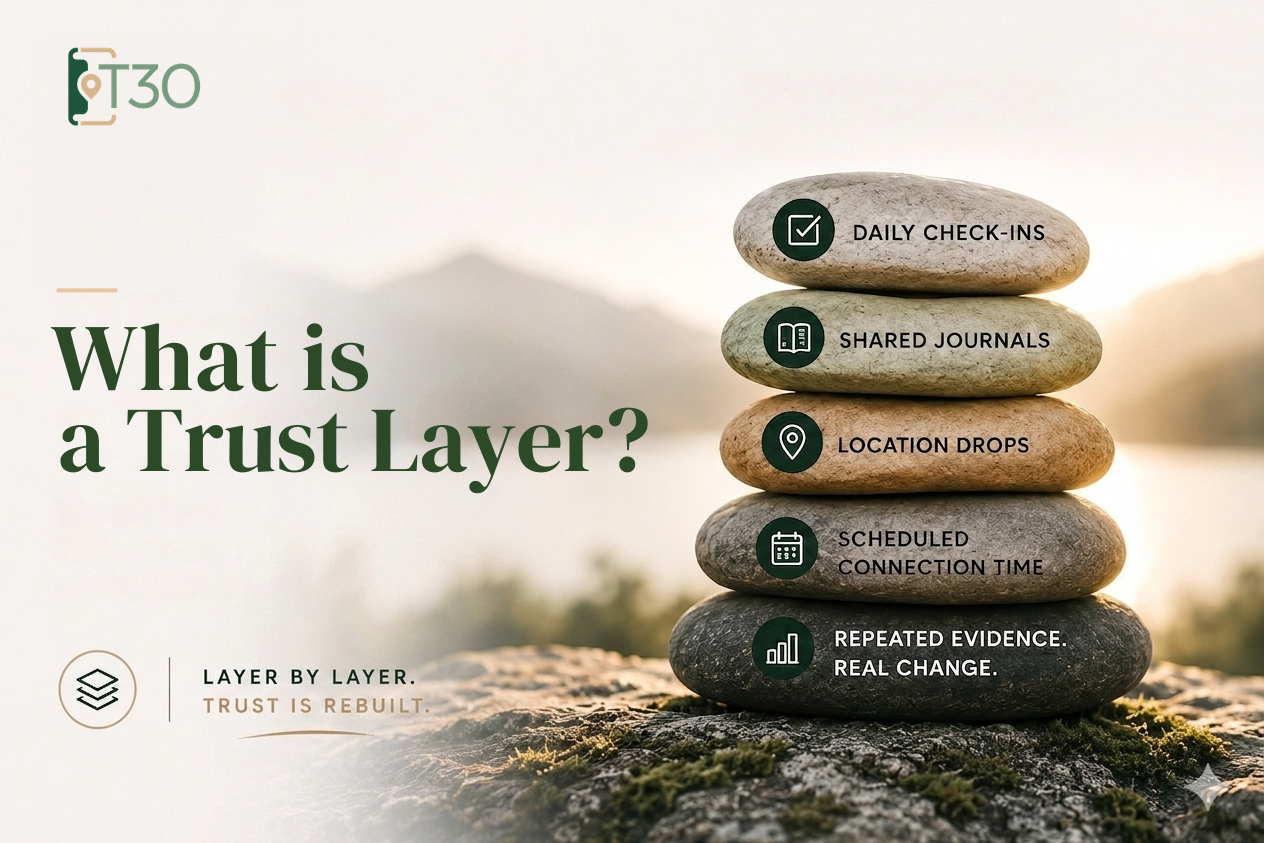
Each trust layer separates intention from action.
A trust layer is any activity inside a relationship that can prove, to a fairly high degree of certainty, that what is happening is real.
Think about how trust develops between strangers. We don't hand someone complete confidence on the day we meet them. We share a conversation, then an experience. A promise is made and kept. Reliability is observed, and over time small pieces of evidence accumulate until trust begins to feel natural.
Betrayal recovery often requires couples to return to this process. And this is where trust-building activities become so important.
At first glance, exercises such as daily check-ins, guided conversations, shared journals, location drops, scheduled connection time may seem simple. But their purpose is not the activity itself. Their purpose is to create evidence. A daily check-in is not valuable because information was exchanged. It is valuable because consistency becomes visible. A shared journal is not important because words were written, it is important because vulnerability becomes observable. She can see your processing in real-time. A scheduled conversation matters because it provides an opportunity to follow through on the commitment made; something that on the macro has been completely broken due to the betrayal.
Each activity, each layer, acts as a filter…as a layer. It separates intention from action.
Anyone can promise change. Anyone can express regret. Trust-building activities answer a more important question: Can those promises be demonstrated consistently over time?
That distinction matters because trust is ultimately based on patterns.
Following betrayal, the injured partner often struggles to believe what they cannot see. The brain is searching for evidence that the relationship is becoming safe again. Large promises rarely provide that evidence, yet small, repeated actions do. These moments may appear insignificant on their own, but together they form a pattern. And patterns are what rebuild broken trust.
This is why recovery often feels less like a breakthrough and more like construction. A massive wrecking ball that destroyed the structure can only be rebuilt brick-by-brick.
Trust layers give couples a way to stop asking whether trust exists and start gathering evidence that it can. Over time those small pieces of evidence become something larger: confidence, safety, and connection.
Not because trust suddenly returned, but because it was patiently rebuilt—one layer at a time.