
How T30 Journal Supports Pornography Addiction Recovery
Pornography addiction recovery is not just about stopping a behavior.
It is about rebuilding honesty.
It is about learning what is happening underneath the behavior.
It is about creating enough structure that secrecy has less room to grow.
And if trust has been broken in the relationship, it is about giving your partner something more than another promise.
Trust is rebuilt through consistent behavior, transparency, emotional honesty, and follow-through. That work does not only happen in therapy. It happens between therapy sessions. It happens in ordinary moments, schedule changes, emotional triggers, moments of temptation, late nights, travel, conflict, stress, and the repeated choices that either create safety or create more uncertainty.
That is where T30 Journal can help.
Pornography Addiction Often Lives in Secrecy
Pornography addiction grows through hidden patterns: deleted history, private rituals, half-truths, minimized behavior, secret accounts, emotional withdrawal, and promises that are made after the damage is already done.
Recovery has to become more than “I will try harder.”
T30 Journal helps create structure through check-ins, journaling, emotional reflection, significant event logs, partner sharing, location drops when appropriate, and shareable reports.
The goal is not to perform recovery.
The goal is to practice honesty in a way that can be seen over time.
Quick Check-Ins as a Recovery Rhythm
One of the simplest ways T30 supports addiction recovery is through daily check-ins.
A check-in is not just a quick “I’m good.”
A real recovery check-in asks better questions:
What am I doing and who am I with?
What am I feeling today?
What do I need?
Where am and how does that location make me feel?
The person in recovery may not always recognize what they are feeling until the pattern has already escalated. Regular check-ins help slow that process down.They create a record of what was happening before a hard moment. They help the person in recovery move from vague awareness to specific ownership.
Not “I don’t know what happened.”
But, “I can see what was building.”
Event Logs Give Relapse Context
Relapse should not be treated casually. It should not be minimized. It should not be hidden. It should not be explained away with vague language or buried under shame. But relapse also should not be treated like a random event with no context.
Most relapses have a buildup.
There are risk factors before the behavior. There may be poor sleep, unmanaged stress, conflict, isolation, secrecy, resentment, boredom, travel, unstructured time, technology access, shame, emotional shutdown, or skipped recovery routines.
T30’s relapse event log type gives the person in a guided experience to document a relapse in the context of their frequent checkins. Patterns become easier to see.
A relapse entry may explain what happened. But the check-ins around it may show what was building before it happened.
Maybe the person had three days of high stress.
Maybe they stopped naming emotions.
Maybe they skipped connection time.
Maybe they started isolating.
Maybe they were angry and did not say it.
Maybe they were overwhelmed and did not reach out.
Maybe they created more ambiguity for their partner instead of more clarity.
That is important recovery data.
Not because data makes relapse acceptable.
It does not.
But because understanding risk factors helps the person in recovery build a better relapse prevention plan.
Patterns Help Create Better Recovery Plans
A person cannot interrupt a pattern they refuse to see.
This is one of the reasons journaling matters in pornography addiction recovery. When check-ins and event logs are used consistently, the person in recovery can begin to identify the conditions that make relapse more likely.
They can start asking:
What tends to happen before I act out?
What emotions do I avoid?
What situations make me more vulnerable?
What boundaries do I ignore first?
What support do I stop using?
What conversations do I avoid?
When do I start creating secrecy again?
What needs to change before the next vulnerable moment?
This moves the recovery conversation away from vague apologies and into specific ownership.
Instead of saying, “I messed up. I’m sorry. It won’t happen again,” the person in recovery can begin saying:
“Here is what happened.”
“Here is what I noticed before it happened.”
“Here are the risk factors I ignored.”
“Here is where I stopped being honest.”
“Here is what I need to change.”
“Here is the support I need to add.”
“Here is how I am repairing the damage.”
That kind of ownership does not erase the pain.
But it does create more clarity than defensiveness, silence, or another unsupported promise.
T30 Helps Replace Secrecy With Chosen Accountability
T30 is not designed to secretly monitor someone.
Recovery accountability should not be built on hidden surveillance. It should be built on chosen transparency, clear agreements, and support that helps both people understand what is happening.
For the person in recovery, T30 creates a place to document the work:
Daily check-ins
Emotional reflection
Needs tracking
Significant event logs
Empathy journaling
Location drops when appropriate
Shared journal entries
Reports that show consistency over time
Healthkit integration to show sleep and actitvity patterns
For the betrayed partner, this can reduce some of the uncertainty that often follows betrayal.
After trust has been broken, silence does not feel neutral. A schedule change may not feel neutral. Emotional distance may not feel neutral. Unexplained behavior may not feel neutral.
The betrayed partner may not be trying to be controlling. They may be trying to feel safe in a relationship where deception was once part of the reality.
T30 helps create structure around that reality.
It gives both people a better way to see whether recovery is being practiced, not just promised.
T30 Supports the Work Between Recovery Conversations
Therapy, coaching, groups, sponsors, mentors, and pastoral care can all be important parts of recovery.
But the real work still happens between those conversations.
It happens when the person in recovery is tired.
It happens when they are triggered.
It happens when they are alone.
It happens when they are tempted to hide.
It happens when their partner asks a hard question.
It happens when there is an opportunity to create clarity before fear fills the space.
T30 helps support that in-between space.
It gives the person in recovery a place to reflect before the conversation. It gives the betrayed partner a clearer record of what is being practiced. It helps bring patterns, triggers, relapse context, repair attempts, and consistency into the light.
Recovery is more than avoiding pornography.
It is about becoming honest.
Becoming emotionally aware.
Becoming safer.
Becoming more consistent.
Becoming someone whose words and actions begin to match over time.
Rebuilding Trust Takes Repeated Evidence
After pornography betrayal, the person in recovery may want trust to return quickly.
The betrayed partner may desperately want to feel safe again.
But trust usually does not come back because someone says, “Believe me.”
Trust comes back slowly.
Through repeated evidence.
Through consistent check-ins.
Through transparency that is offered before it is demanded.
Through emotional honesty.
Through repaired ruptures.
Through patterns that show change over time.
T30 Journal was built for that kind of work.
Not as the whole recovery plan.
But as a trust layer that helps recovery become visible.
Because when trust has been broken, recovery needs more than intention.
It needs a record of honesty being practiced.
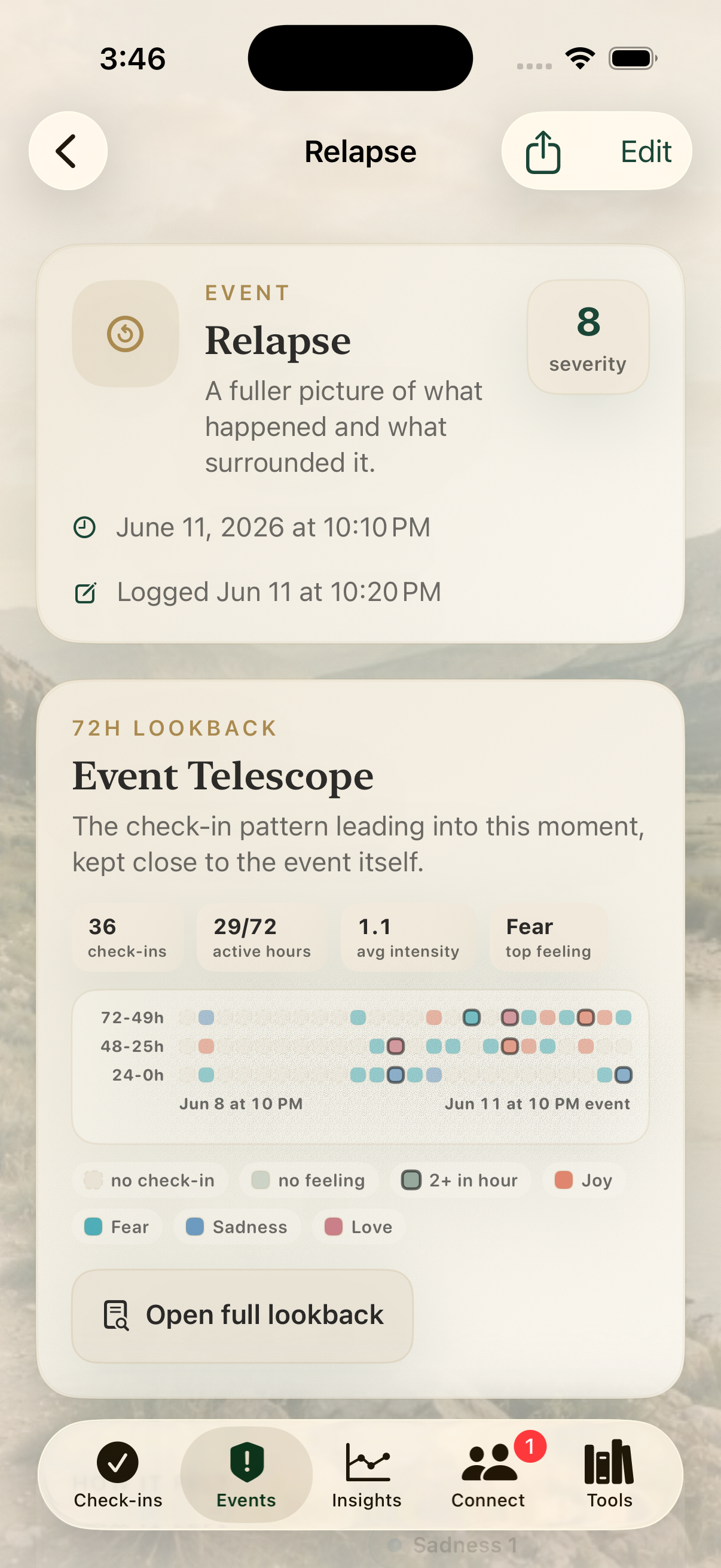
Event Log Type: Relapse
The event telescope provides an emotional 72 hour lookback on the checkins that were occurring.
Did check-in frequency drop off? Maybe thats a signal to the partner.
Are there no mention of uncomfortable feelings?
Maybe there is some avoidance.
Completely stuck and confused?
Export and share a PDF for a friend or therapist to review with you.